How a Tiny Moving String Changed the Future of Cardiac Monitoring
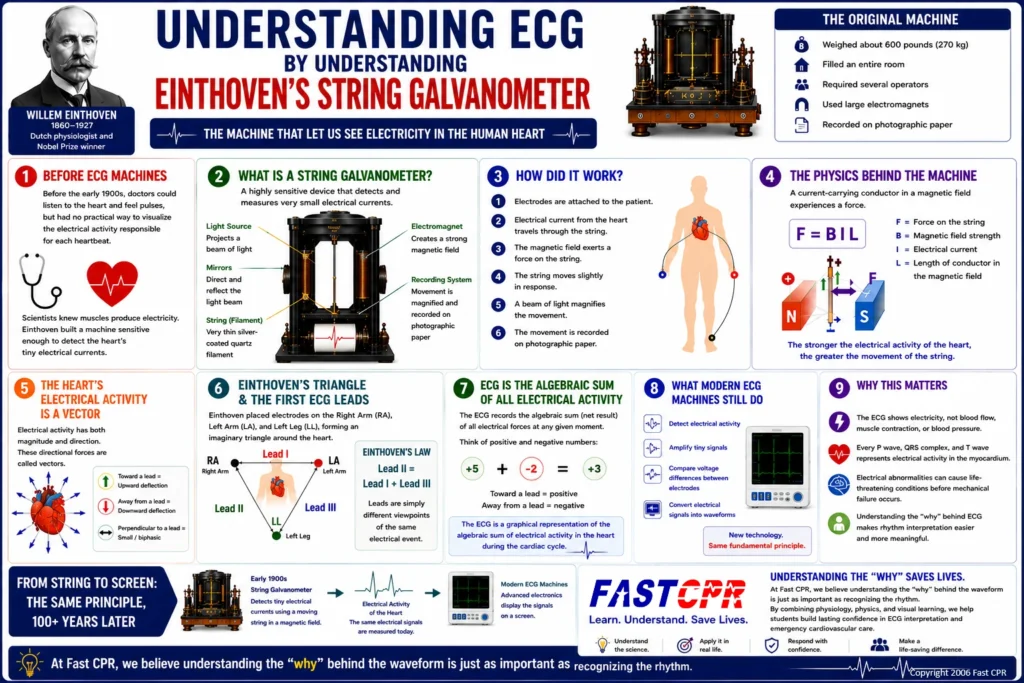
Every day, ECG machines help healthcare professionals see what the human eye cannot — the electrical activity happening inside the heart. Understanding ECG and Einthoven’s String Galvanometer provides important context for how these vital readings became possible in medicine.
A modern ECG (also called an EKG) can display a heartbeat in seconds. A few electrodes placed on the skin detect tiny electrical signals, and those signals become the familiar waves used in cardiac monitoring.
But before digital ECG machines, computer screens, and portable heart monitors, scientists faced a major challenge:
How do you turn invisible electrical activity from the heart into something you can actually see?
The answer came from Dutch scientist Willem Einthoven and his revolutionary invention:
The String Galvanometer.
This invention became the foundation of the modern electrocardiogram (ECG) and changed the way healthcare professionals understand the heart.
The Heart: A Biological Electrical System
To understand ECG interpretation, we first have to understand that the heart is not only a pump — it is also an electrical system.
Every heartbeat begins with tiny electrical signals created by specialized heart cells. These signals control the timing and coordination of heart muscle contraction.
This process includes:
Depolarization → electrical activation that leads to heart muscle contraction
Repolarization → electrical recovery that prepares the heart for the next beat
These electrical signals are extremely small.
The heart’s electrical activity is measured in millivolts, or thousandths of a volt. A special device was needed to detect, amplify, and record these tiny changes.
That need led to the development of Einthoven’s String Galvanometer.
What Is a Galvanometer and How Does It Work?
A galvanometer is an instrument designed to detect and measure electrical current.
The basic concept:
Electrical current → Magnetic field → Movement → Measurement
When electrical current moves through a conductor inside a magnetic field, it creates movement.
That movement helps determine:
• The presence of electricity
• The direction electrical current is traveling
• The strength of the electrical signal
This simple physics principle became the foundation for recording the electrical activity of the heart.
Einthoven’s String Galvanometer: The Beginning of the ECG
Willem Einthoven improved earlier galvanometers by replacing heavy moving parts with an extremely thin conductive string.
The string galvanometer contained:
• A thin quartz filament coated with metal
• Powerful electromagnets
• A microscope system
• A photographic recording system
The patient was connected using electrodes, allowing the device to detect electrical activity traveling through the body.
The process worked like this:
Heart creates electrical activity
↓
Signals travel through the body
↓
Electrodes detect the signals
↓
Current moves through the thin string
↓
Magnetic forces move the string
↓
Movement is magnified and recorded
↓
An ECG waveform is created
For the first time, the invisible electrical language of the heart became visible.
Why Does an ECG Have Waves?
An ECG does not directly show the heart squeezing.
It shows the movement of electrical activity through the heart.
When electrical activity moves toward a positive electrode:
→ The ECG shows an upward movement
When electrical activity moves away:
→ The ECG shows a downward movement
When electrical forces return to balance:
→ The ECG moves back toward baseline
These electrical changes create the familiar ECG waveform:
P Wave
Represents electrical activation of the atria
QRS Complex
Represents electrical activation of the ventricles
T Wave
Represents electrical recovery of the ventricles
Each ECG wave represents a specific part of the cardiac electrical cycle.
Einthoven’s Triangle: Mapping Electrical Activity of the Heart
Einthoven discovered that viewing the heart’s electrical activity from different angles provided more information.
By using electrodes on:
• Right arm
• Left arm
• Left leg
he created three viewpoints:
Lead I
Right Arm → Left Arm
Lead II
Right Arm → Left Leg
Lead III
Left Arm → Left Leg
Together these views formed Einthoven’s Triangle.
This discovery allowed healthcare professionals to analyze the direction and movement of electrical impulses through the heart.
The ECG was no longer just detecting electricity.
It was creating a map of the heart’s electrical behavior.
From Einthoven’s Machine to Modern ECG Technology
The original string galvanometer was a massive machine.
It weighed hundreds of pounds, required multiple people to operate, and patients placed their limbs into containers of salt water to improve electrical conduction.
Today, the same scientific principles are found inside:
• Hospital ECG machines
• Emergency cardiac monitors
• Portable ECG devices
• Wearable heart technology
The equipment became smaller.
The purpose stayed the same:
Detect the heart’s electrical signals, process them, and create a visual representation.
Why Understanding Einthoven Helps With Learning ECG
Many people try to memorize ECG rhythms without understanding what the ECG machine is actually measuring.
An ECG is not simply a line moving across a screen.
It is a combination of:
Physics + Electricity + Biology
Heart cells create electrical activity.
Electrical activity creates measurable signals.
Those signals create waves.
Those waves help tell the story of what is happening inside the heart.
Understanding Einthoven’s String Galvanometer helps explain the foundation behind every ECG tracing used today.
Fast CPR Learning Approach
At Fast CPR, we believe understanding is more powerful than memorization.
We focus on making complicated healthcare concepts simple, practical, and easier to understand.
Modern healthcare is built on science, but good training turns science into action.
Learn the concept.
Understand the reason.
Perform the skill.
© Fast CPR